
REVIEW · GLASGOW TOURS & DAY TRIPS
Glasgow Private Self-Guided Tour
Glasgow tells its story in layers. This self-guided route is built around GPS directions and an audio guide by Alex, so you can roam through centuries of faith, civic life, and street art at your own speed. I love how the tour braids together major sights (Glasgow Cathedral and the Necropolis) with mural stops you can actually stand in front of and study. One caution: the app experience can feel fussy at times, like when you need to switch to the map and back, and that can break your flow.
For value, this is hard to beat. At $12.37 per person, you’re basically buying a structured walk plus an audio story trail, and many stops are listed as admission ticket free. Also, this is not a live guided group tour, so you won’t be rushed or herded.
If you want a simple plan that still feels personal, this works well for me and you. Just come with decent walking shoes and expect a lot of stops where you’ll want to pause for photos and details.
In This Review
- Key points before you go
- Starting at Glasgow Cathedral on Castle Street
- Glasgow Necropolis: a graveyard built to impress
- Provand’s Lordship and a medieval-ish vibe in stone
- Glasgow murals on the move, with Strathclyde University and beyond
- The St Enoch cradling St Mungo mural, then more street art details
- A fifteenth-century feel: civic roles and a tower that changed use
- Tron church tower, Trongate, and the Saint Enoch connection
- Police history museum and Smug’s fairy-tale street scene
- 98 Ingram Street: Ramshorn-era tombs, tobacco merchants, and tea room design
- Mercury statue, City Chambers, and George Square’s Georgian grid
- A quirky emblem, an art gallery stop, and modern Glasgow on the way out
- Lighthouse visitor centre near St Enoch: finish with one last mural
- Price and pacing, plus how to avoid app frustration
- Should you book this Glasgow private self-guided tour?
- FAQ
- Is this a live guided tour?
- How long does the Glasgow private self-guided tour take?
- What language is the audio guide offered in?
- Where does the tour start and where does it end?
- Do I need to download an app to use the tour?
- Are there entrance fees included?
- Can service animals join the tour?
- Is the tour refundable if I cancel?
Key points before you go
- Glasgow Cathedral after the 1136 fire: a living place of worship that has been roofed and active for centuries
- Necropolis scale you can picture: 37 acres, roughly the size of many soccer fields combined
- Street art with a purpose: murals are presented as way to revive neglected walls and shift views on street art
- Smug murals on the route: photo-ready stops featuring detailed scenes and fairy-tale style imagery
- Merchant City stops: Mercury statue, City Chambers, and George Square keep the story moving toward modern Glasgow
- End near St Enoch Subway: a convenient finish point that helps you keep exploring
Starting at Glasgow Cathedral on Castle Street
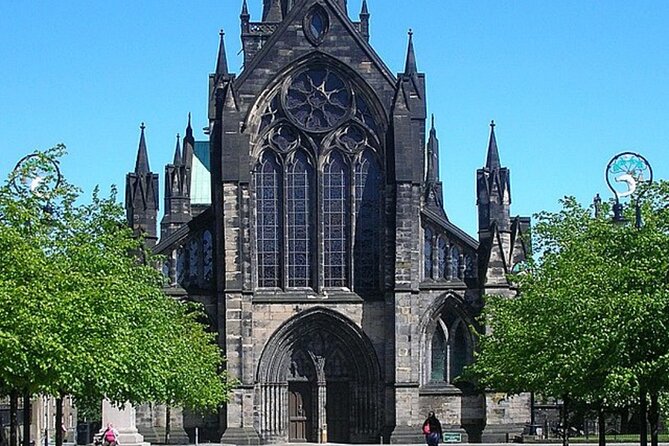
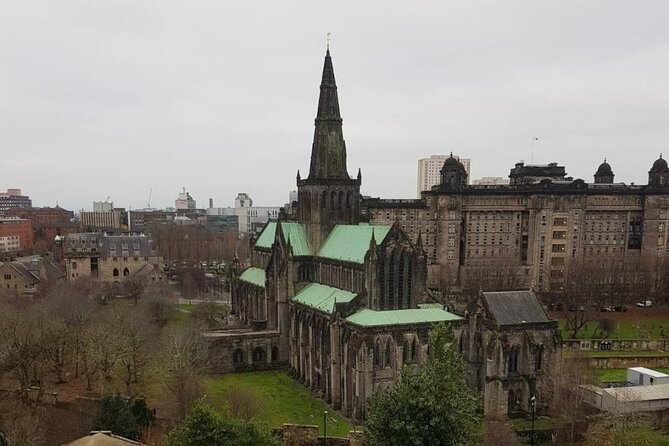
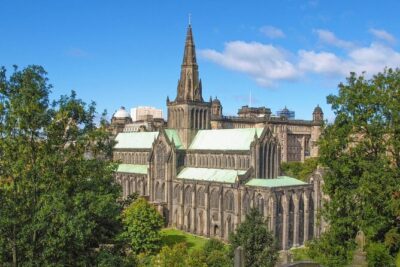
Your walk begins at Glasgow Cathedral on Castle Street, and it’s a great first move because it sets the timeline fast. This cathedral traces back to 1197, built after an earlier cathedral (from 1136) fell to fire. The big takeaway is continuity: worship has taken place in these walls for more than 800 years.
You’ll get an audio segment that frames the cathedral as one of Glasgow’s emblems, then zooms out to the surrounding area. That matters because cathedrals can turn into just “pretty stone” if you don’t have a story hook. Here, you get a reason to look carefully at details and understand why the building mattered then, and still matters now.
Practical note: the stop is set for about 30 minutes, but give yourself extra time if you like inscriptions, tombs, and architectural clues. If your audio volume is low on your phone, you might want to boost it early, so you’re not stuck squinting and guessing later.
Glasgow Necropolis: a graveyard built to impress
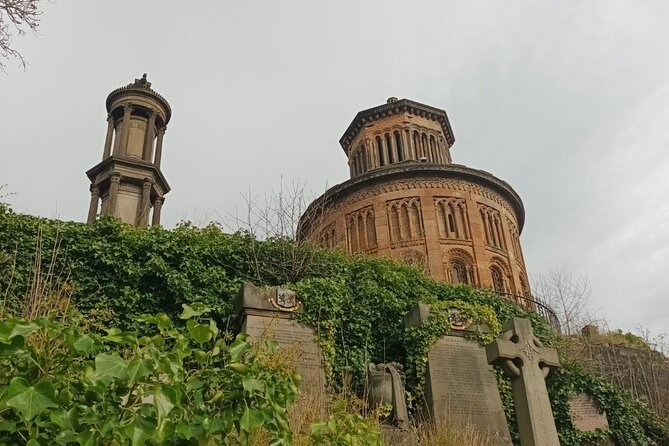
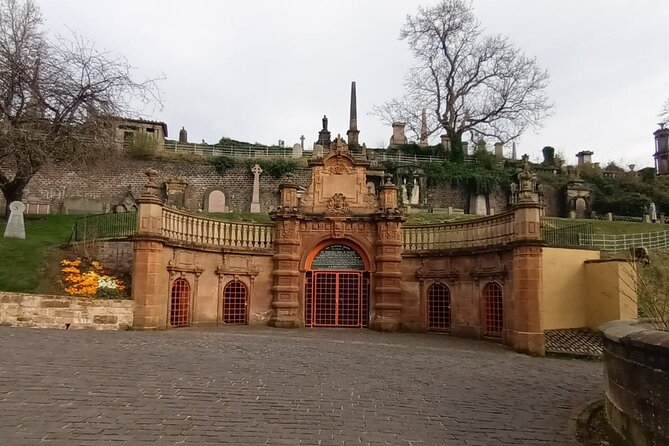
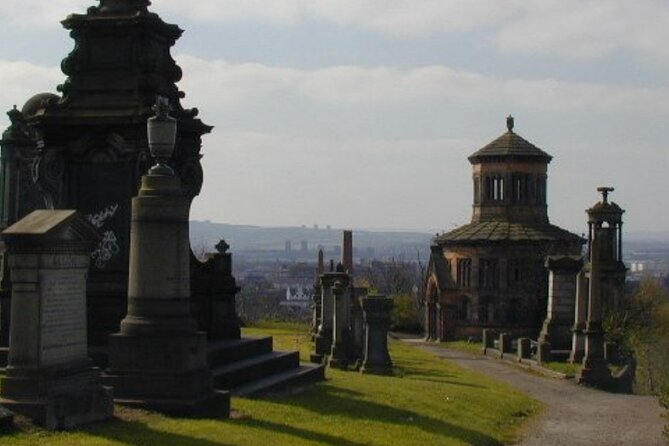
Next up is the Glasgow Necropolis, Glasgow’s best-known graveyard. It was established in 1831 and intentionally copied the idea behind Paris’s Père Lachaise. The tour frames it as a status statement: in the early 1800s, wealthy Glaswegians wanted a strong public message even after death.
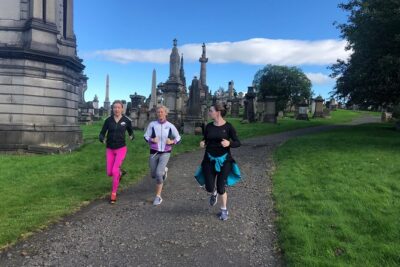
What you’ll love here is scale. The necropolis stretches over 37 acres, described as about the size of 15 soccer fields, or roughly 150,000 square meters. Even if you don’t pace every path, the audio helps you “read” the place as a planned monument, not a random cemetery you pass through.
There’s also a mood shift. In a cathedral, you’re thinking upward. In a necropolis, you’re thinking time, legacy, and how a city displays wealth and memory. The stop is set for about 15 minutes, but it’s the kind of place where an extra 10 minutes for slow looking can pay off.
What else runs out of Glasgow
- Guided Celtic Park Stadium Tour
★ 5.0 · 3,136 reviews - City Sightseeing Glasgow Hop-On Hop-Off Bus Tour
★ 4.5 · 1,873 reviews - Oban, Glencoe, Highlands Lochs & Castles Small Group Day Tour from Glasgow
★ 5.0 · 1,432 reviews - Glasgow City Centre Walking Tour with Local Guide
★ 5.0 · 1,326 reviews
Provand’s Lordship and a medieval-ish vibe in stone
As you continue, you’ll hit a lovely stone building called Provand’s Lordship, a name that’s been used since the late nineteenth century. Before that, it was known as the Hospital of St Nicholas.
This is one of those stops that doesn’t scream for attention, but it rewards you for leaning in. The audio ties the building to older functions and helps you notice how a place changes roles over time. That’s a key theme of this tour: Glasgow isn’t stuck in one era, it’s stacked.
If you like architecture and local history that feels grounded, you’ll appreciate this kind of stop. It’s also a good reset after the necropolis, because it’s smaller and more focused.
Glasgow murals on the move, with Strathclyde University and beyond
One of the tour’s main attractions is how it uses murals to tell a cultural story. The audio explains that murals were created to revitalize neglected walls and gable ends, and to change perceptions about street art. That’s not just a pitch. It changes how you view what you’re seeing, because you start asking who made it, why it’s there, and what the city hoped it would do.
A key stop is University of Strathclyde, one of Glasgow’s three major universities. The tour treats it as a must-see mix of interesting architecture and mural sightings, and it’s a nice example of how art and everyday city life coexist.
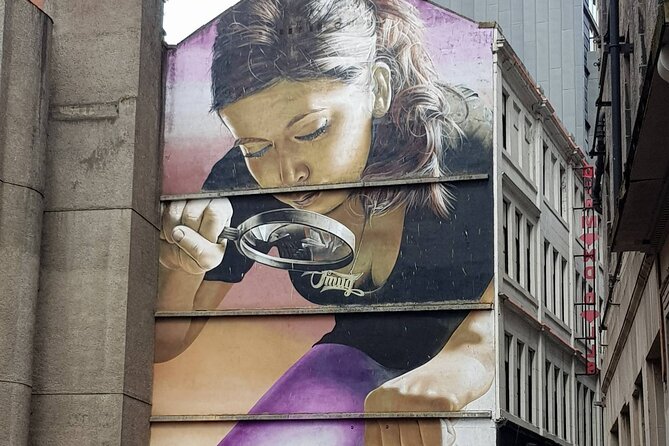
You’ll also find yourself at a specific mural moment tied to saints. One stop highlights a St Enoch mural that shows a mother cradling a baby, presented as a futuristic representation of St Mungo. Even without knowing the full legend, this is the kind of mural where you can read body language, symbolism, and style choices quickly.
Timing here is short on purpose, but it gives you a fast hit of what makes Glasgow visual culture different from just “seeing buildings.”
The St Enoch cradling St Mungo mural, then more street art details
This is one of those rapid stop moments where the audio matters most. The mural you’ll see is described as St Enoch cradling St Mungo, and the tour points you to the incredible details and history of the saint connected to the image.
Even if you’re not a mural superfan, this stop can still land because it’s human. You’re looking at a scene meant to feel intimate, not distant. The tour’s job is to help you notice what’s depicted and why it connects to Glasgow’s saint story.
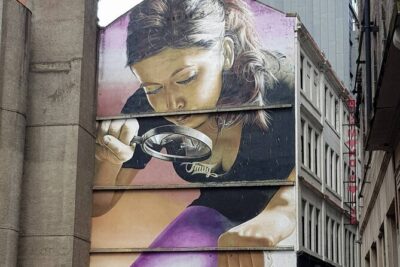
Then you’ll keep moving through additional mural stops, including a Smug piece called Fellow Residents of Glasgow. That mural shows a hiker foraging for mushrooms in woodland-like surroundings, with animals appearing as if they’re visible through holes in the wall. It has a fairy-tale feel, and the tour’s focus on “details you might miss” is exactly what makes these short stops worth it.
A fifteenth-century feel: civic roles and a tower that changed use
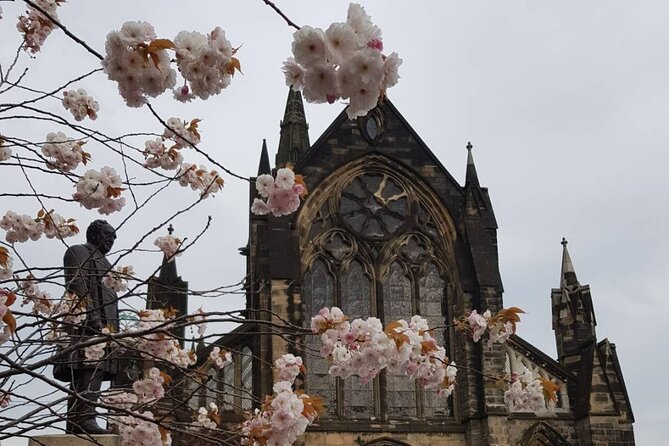
Midway through the route, the tour slows your thinking in a different direction. You’ll be pointed toward a stone building associated with early records around 1626, and it’s presented as having an official record in the early modern period, with roots described as early as the fifteenth century.
The audio explains how it served as the Town Clerk’s office, then the Justice Court, then the Town Council, and at the top for security reasons it was used as the jail. The point isn’t to memorize job titles. The point is to watch a single structure take on different civic purposes as the city’s needs shifted.
If you like understanding how governments and institutions worked in real space, this stop is a strong one. If you’re just chasing photo ops, you may want to keep your attention on windows, stonework, and any cues about how secure areas were made and used.
Somebody local doing the talking, on other days out



Tron church tower, Trongate, and the Saint Enoch connection
As you move into the Trongate area, you’ll be looking at the tower of what is now the Tron Theatre, explained as originally linked to the Tron church. The street name Trongate is tied to a older naming idea, including that it was known as Saint Thenew’s Gait because it ran along the route to the supposed site of Thenew’s burial.
Here’s the saint link the audio pushes: Thenew is the woman you know today as Saint Enoch, and she is identified as Saint Mungo’s mother. That’s a clever way to connect street names and religion without turning it into a lecture.
This stop also helps you understand why Glasgow’s religious and civic stories overlap in the street layout. You’re not only seeing a tower, you’re seeing why the tower matters to the city’s identity.
Police history museum and Smug’s fairy-tale street scene
Glasgow is known for personality, and one stop underscores that through its institutions. The tour mentions that Glasgow had the first police force in all of Great Britain, with history from 1800 to 1975 displayed in a museum. The audio aims to give you insight into the people, events, and other factors that contributed to that police force’s founding and development.
This is a useful contrast if your mental picture of “Glasgow history” is mostly churches and industry. Police history sounds narrow, but it often reveals social change, public order, and city growth. Even if you don’t plan to spend long inside, the stop is still worth it for context.
Then it’s back outside to the mural trail. One Smug mural is described as Fellow Residents of Glasgow, with animals you can find in Glasgow’s parks and green spaces, shown through wall-like holes. The tour basically gives you permission to slow down and look at the wall as a living canvas, not just a background for selfies.
98 Ingram Street: Ramshorn-era tombs, tobacco merchants, and tea room design
One of the most interesting segments is around 98 Ingram St because it layers a few different Glasgow stories in a small area.
First, the audio describes a church originally built in 1824, replacing an older version. It’s designed by English architect Thomas Rickman in the gothic revival style. On the graveyard, you’ll see the graves of tobacco merchants Andrew Buchanan and John Glassford.
The tour also connects burial fashion to the necropolis shift. It explains that the older Ramshorn cemetery, now partly covered by Ingram Street, used to be the “fashionable” and expensive place to be buried in the eighteenth century, before the Necropolis became the new statement.
Then you get the design story that links Glasgow’s art to everyday life. The tour describes a tea room interior inspired by Charles Rennie Mackintosh, and it says the tea room itself is modeled on Kate Cranston’s Ingram Street tea rooms from the early 1900s. It’s a great moment because it shows you how architecture and social rituals merge.
Practical tip: this stop is set for about five minutes, so if you want to read tomb names or take in the design details closely, consider extending your time by a few minutes and tightening elsewhere.
Mercury statue, City Chambers, and George Square’s Georgian grid
Next your eyes head toward Merchant City symbolism. One stop points out a statue of Mercury, described as the Roman god of financial gain, commerce, eloquence, poetry, travelers, boundaries, luck, trickery, and thieves. It’s presented as one of two Mercury sculptures by Alexander Sandy Stoddart, and the audio says the statues represent the Italian quarter of Merchant City.
From there, you move to the City Chambers, completed in 1888 and inaugurated by Queen Victoria, whose presence is noted through a statue opposite on George Square. The tour also includes a fun historical connection involving a famous registry office in London, tied to the City Chambers.
Then you get George Square itself. The audio explains it’s named after King George III, and that it was laid out as early as 1781 as part of a Georgian grid city center plan. Development took another 20 years, so the square’s shape reflects a long build cycle.
This part is great for understanding Glasgow’s self-image. It’s not all hard times. It’s civic pride and the message a city sends through its public buildings.
A quirky emblem, an art gallery stop, and modern Glasgow on the way out
At this point, the tour promises an emblem of Glasgow that might feel a bit bizarre, and it connects the oddness to the city’s sense of humor. I like this style of pacing because it breaks the pattern of “serious stone and dates.” Glasgow has always had a wink in its storytelling, and a tour that adds humor helps you keep energy up.
You’ll also get a must-visit gallery stop, with the audio promising details you need to understand it. The route then moves into the tea room design story already mentioned, so even if your main interest is murals or cathedrals, you still end up with a strong art and design thread.
Finally, the tour arrives at Buchanan Street, described as a move into the twenty-first century. It ties the walk together, from the cathedral era, through tobacco merchant power, through street-level shenanigans you’ve been hearing about along the way, and into present-day city energy.
Lighthouse visitor centre near St Enoch: finish with one last mural
You end your walk on a practical note near St Enoch Subway Station. The tour also mentions finishing close to the Roman Fort, which gives you that satisfying sense of “this area keeps layering older and newer Glasgow.”
Before the finish, there are two final visual moments. The route passes by The Lighthouse, described as a visitor centre, exhibition space, and event venue in the heart of Glasgow. And it includes a last Smug mural called Honey, I shrunk the Kids, described as photo realistic street art.
This ending works well if you plan to keep moving. You’re not stuck back at the starting point with no transit. You’re placed at a hub.
Price and pacing, plus how to avoid app frustration
At $12.37 per person, you’re paying for structure, narration, and navigation. That’s the real value here. You’re not just buying “random facts.” You’re buying a route that tells you where to go, when to pause, and what to notice once you’re there.
The tour is listed as about 2 to 3 hours, and that’s realistic if you keep your stops tight. But you can easily stretch it if you love murals and architecture. The best part of self-guided walking is control. You can stand in front of the St Enoch mural longer, or you can speed through smaller streets if you’re short on time.
Now the downside to plan for: the app experience can be clunky. Some people find it annoying when the app navigation requires switching to the map and then coming back, and that can cause you to lose your place. The fix is simple: set your phone volume, keep your screen brightness comfortable, and pause at each stop before you switch apps. Also, if your audio seems quiet, check your phone’s volume and any headphone settings right away.
Lastly, audio is by Alex, and it’s not computer-generated. That human narration can feel warmer than robotic guides, and it’s a big reason this tour is enjoyable even when you’re just passing from one street to the next.
Should you book this Glasgow private self-guided tour?
Book it if you want a low-cost, walkable way to connect Glasgow Cathedral, the Necropolis, and street art into one coherent route. This is especially good for you if you like history but also want modern culture right in the same day, with short stops that let you browse at your pace.
Skip it or adjust your expectations if you’re the type who gets annoyed by app-based navigation. If you need a perfectly smooth, hands-free guide, you might prefer a live guided tour instead. Also, if you’re sensitive to audio quality, do a quick volume check before you start.
If your goal is to get your bearings fast, then wander with confidence, this is a solid choice. It gives you enough structure to feel grounded, and enough flexibility to follow your curiosity when the murals and stone details pull you off script.
FAQ
Is this a live guided tour?
No. This is a private self-guided experience, so you use the app and follow the route with the audio guide.
How long does the Glasgow private self-guided tour take?
The tour is listed as about 2 to 3 hours.
What language is the audio guide offered in?
It’s offered in English.
Where does the tour start and where does it end?
It starts at Glasgow Cathedral on Castle Street (Glasgow G4 0QZ) and ends at St Enoch Subway Station (Glasgow G1 4BW).
Do I need to download an app to use the tour?
Yes. You need to download the Pandemic Tours app after your booking is confirmed.
Are there entrance fees included?
The tour does not include any entrance fees for attractions mentioned. Some stops are marked as admission ticket free, but entrance fees are listed as not included overall.
Can service animals join the tour?
Yes, service animals are allowed.
Is the tour refundable if I cancel?
No. This experience is non-refundable and cannot be changed for any reason.
A Wider Spread of Tours



The Rest of What We Wrote Up
What Else Leaves Glasgow
Newest write-ups around Glasgow
- The Scottish Highlands Photography Tour & Workshop★ 5.0 · 3 reviews
- Scottish Highland Day Tour from Glasgow★ 5.0 · 3 reviews
- Whisky Adventure – Private Day Tour from Glasgow★ 5.0 · 3 reviews
- 3 Day Isle of Skye Eilean Donan Castle and Loch Ness Tour★ 5.0 · 3 reviews
- Pints & Past: Glasgow Pub Tour Private Tour★ 5.0 · 3 reviews
Glasgow Tours & Day Trips, compared.
 ★ 5.0Guided Celtic Park Stadium TourFrom $253,136 reviews
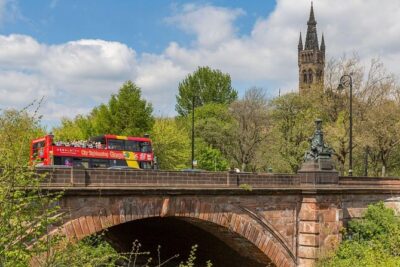 ★ 4.5City Sightseeing Glasgow Hop-On Hop-Off Bus TourFrom $271,873 reviews
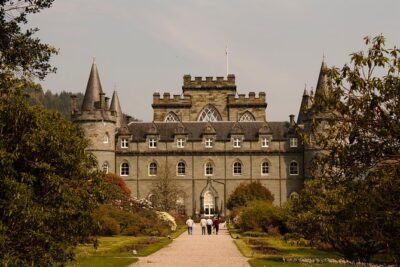 ★ 5.0Oban, Glencoe, Highlands Lochs & Castles Small Group Day Tour from GlasgowFrom $501,432 reviews
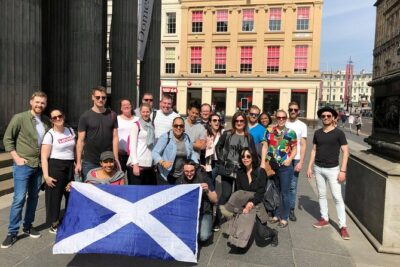 ★ 5.0Glasgow City Centre Walking Tour with Local GuideFrom $161,326 reviews
 ★ 5.0Loch Ness & the Highlands Day Tour from Glasgow Including CruiseFrom $831,211 reviews
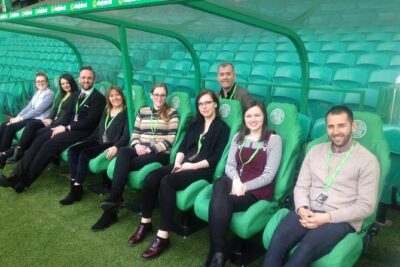 ★ 5.0Celtic Park Tour & Dine PackageFrom $60998 reviews
 ★ 4.5Loch Ness, Glencoe, and the Highlands Day TourFrom $76806 reviews
 ★ 4.5Glasgow Afternoon Tea ExperienceFrom $61735 reviews
Browse the lists this tour appears in